
Ads AgentNovember 3, 20266 min read
What Meta's Ad System Does Before Your Thumb Moves: A Stage-by-Stage Guide for Growth Teams
Meta now scores every eligible ad at over a billion a second. Stage by stage, what that means for growth teams and what your ad agent should do.
By Satish Polisetti
TL;DR Meta's October 28 engineering post says it now scores every eligible ad, at over a billion ads per second on one server. Volume alone is no longer an edge, and tuning delivery is Meta's job now. What's left for your team: decide what a customer is worth. Your agent tells every platform.
On October 28, Meta's engineers published how they rebuilt Andromeda, the retrieval stage of its ad system. A week earlier, Sukhesh Miryala, a director of product at Meta who leads ad delivery, walked through the rest on Marketing Operators.
How much faster Meta's retrieval got in two years
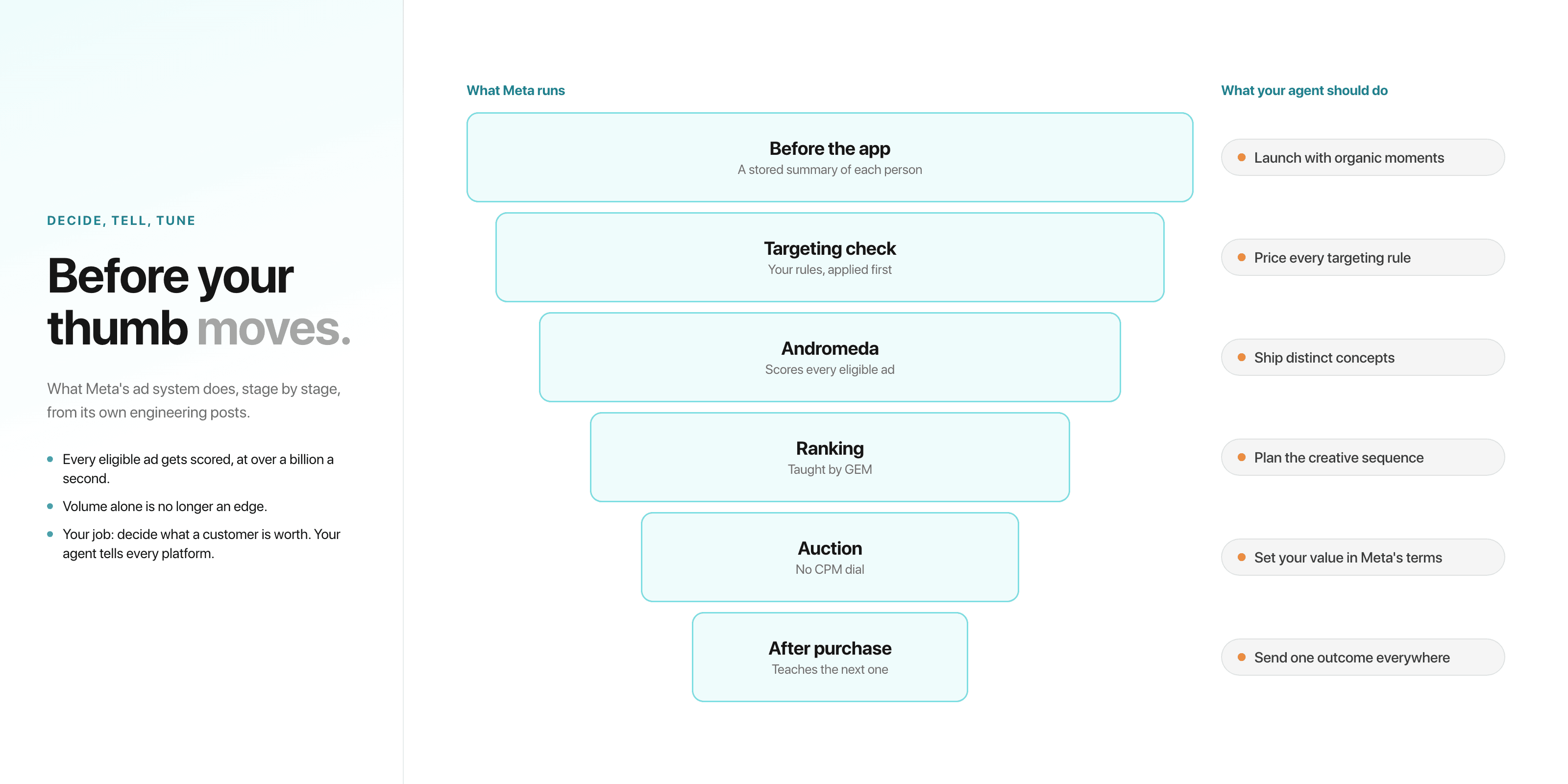
Most of it is about GPUs. Read with Meta's older posts, it lets you follow one impression through six stages, each of which changes a brand's decisions. Meta's figures are its own and unaudited. The staging, the illustrations and the lines marked "my read" are mine.
The six stages
0. Before you open the app
Meta says: a user model reads thousands of a person's past events, like views, clicks and purchases, then computes a summary ahead of time and stores it. Its GEM model separately trains on both ad and organic interactions.
So what for your brand? Your ad doesn't arrive cold. Miryala says intent already built by creators and trust gets you more conversions for the same dollars.
Your ad agent should: line up paid with what's already moving people. When a creator post or press moment lands, launch the matching concept while it's moving.
One person's history
One person's history. Illustration, not data: hundreds of small dots, each a view, click, purchase or touch with your brand, collapse into one stored summary of the person, ready before they open the app.
1. The targeting check
Meta says: before any scoring, your targeting rules are applied in full.
So what for your brand? Miryala says a restricted account competes in fewer auctions than a broad, value-aligned one. The models find your buyers now.
Your ad agent should: say what each rule costs in reach. Keep the ones that protect something real, like regions you can't ship to, and drop the rest.
Impressions your ad can compete for
Broad: this ad can compete wherever Meta thinks it fits. Turn on a rule to see what it costs.
Impressions your ad can compete for. Illustration, not data: a grid of impressions an ad can compete for. A rule for regions you can't ship to removes a few and is worth keeping. A narrow interest audience and stacked exclusions remove many, and each removed impression is an auction the ad never enters, however good it is.
2. Retrieval: Andromeda
Meta says: AI creative tools added hundreds of millions of ads, so Meta rebuilt this stage to score every eligible ad, 100x faster than its 2024 system. Before, many ads were cut off before they were ever considered. Each person is now modelled as a set of "user experts" for different, changing interests, and each ad is routed to the experts it fits.
So what for your brand? Miryala says more, more diverse creative helps the system match. My read: volume alone is no edge, because everyone has it, and variations of one idea go after the same interest. An ad that speaks clearly to one motive has a door to walk through. One that tries every motive gives the system less to match.
Your ad agent should: count concepts, not ads. Brief by motive instead of format, and fill the motives with no ad.
Ten ads, five interests
Ten ads, one door. The ad count looks healthy; the interests reached don't.
Ten ads, five interests. Illustration, not data: ten variations of one idea all connect to one interest, self-care. Ten distinct ideas connect to all five example interests: gifting, self-care, saving money, a problem to solve and status. The number to track is concepts, not ads.
3. Ranking: GEM
Meta says: GEM, Meta's giant foundation model, teaches the hundreds of smaller models that rank ads. They weigh a person's past behaviour against the specific ad, and features describing the ad's content help most for new ads and new advertisers.
So what for your brand? Miryala says a new account's high early cost may just be less data to predict with, not a penalty. My read: someone who browsed and left should see proof or an offer, not your introduction again.
Your ad agent should: plan creative as a sequence across campaigns: introduce, prove, offer.
Same three ads, different person
Same three ads, different person. Illustration, not data: three ads for an invented serum brand reorder by what the person has done. Never heard of you: introduce, prove, offer. Watched a video: prove, offer, introduce. Browsed and left: offer, prove, introduce.
4. The auction
Meta says: there's no CPM dial. Price is an outcome of supply and demand: how many people are on Meta's apps and how many advertisers want that impression. It moves with the season. The most common mistake Miryala sees is marketers crediting their own last change for those swings. Miryala's advice is to stop tuning knobs and steer with value optimization and value rules.
So what for your brand? A CPM swing is usually the market, not a verdict on your brand. What you can change is what you tell Meta a sale is worth.
Your ad agent should: hold your value for each product line and set it with value optimization and value rules. Never react to one day's CPM.
Drag the demand. Your ad doesn't change
Few advertisers want this impression, so it's cheap. You didn't do anything clever.
Drag the demand. Your ad doesn't change. Illustration, not data: as demand rises from a quiet week to a peak holiday week, more advertisers compete for the impression and its price rises, while your ad and audience stay exactly the same. That's the market, not a verdict on your brand.
5. After the purchase
Meta says: The prediction system looks for whatever you point it at, Miryala says, and GEM keeps training online.
So what for your brand? The outcome you send is an instruction. Send the wrong one, and the system gets better at finding the wrong customer.
Your ad agent should: send what you actually value, like margin or a new customer, with the same definition on every channel.
Same two customers. What you send decides who Meta looks for
Meta is pointed at people like A: bigger orders, thinner margin.
Same two customers. What you send decides who Meta looks for. Illustration, not data: customer A is returning, with a $200 order and $20 margin. Customer B is new, with an $80 order and $40 margin. Send revenue and Meta is pointed at people like A. Send margin from new customers and it is pointed at people like B.
Decide, tell, tune
Meta has made producing ads and matching them to people cheap. It can't supply what a customer is worth, distinct ideas, sensible limits or patience.
| Seat | Who | What |
|---|---|---|
| Decide | Your marketer | What a customer is worth, the big creative bets, what gets approved |
| Tell | Your ad agent | Value in each platform's terms, distinct concepts, spend thresholds, one outcome everywhere |
| Tune | The platform's autopilot | Which ads compete, how they rank, what the impression costs |
My read: most agency and media-buying work was built around that third row, with hours in the account and a weekly explanation for every swing. Meta runs that row now.
Meta's autopilot only tunes Meta. It will never tell you the next dollar belongs on Google.
MightyAI agents manage Meta ads, Google Ads, ChatGPT ads and AppLovin for DTC brands on Shopify, and you approve before anything spends.
What to do this week
You can do all four by hand this week. Only the first has to stay yours. The other three never stay done: new ads arrive, rules pile up, and every channel has its own version. That's the work to hand to an agent.
-
Write one sentence per product line on what a sale is worth.
-
Count your concepts, not your ads. Group your live ads by idea, then name the motive that has no ad.
-
Give every targeting rule a reason. List your audiences and exclusions, and drop any without a stated reason.
-
Set a spend threshold before judging a new ad. The rule I'd start with is about 2x your target CAC: if it has spent that with no purchases, cut it. If it hasn't spent that in a week, Meta probably isn't favouring it, so don't read much into its CPA.
If your team stopped touching bids tomorrow, what would they work on instead?
Questions growth teams ask
What is Meta Andromeda? The retrieval stage of Meta's ad system. It applies targeting rules, then narrows every eligible ad down to a small set of candidates for ranking. Meta says the 2026 version handles over one billion ads per second on one server.
What is Meta's GEM model? GEM, the Generative Ads Recommendation Model, is a large foundation model that teaches the hundreds of smaller models that rank ads.
What is Meta Lattice, and how does it relate to GEM? Lattice is a 2023 architecture that merged hundreds of models into one. I haven't found where Meta says how Lattice and GEM fit together today.
What should an agent that manages Meta ads do? Tell Meta what a sale is worth, keep distinct concepts flowing, limit targeting rules to ones with a reason, and send the right outcome. Leave who sees which ad to Meta's system.
Corrections and disagreements to [email protected].