
Ads AgentNovember 2, 20265 min read
What Growth Teams Can Learn From Anthropic's S-1
Everyone summarized Anthropic's S-1 as a story about scale. The line items tell a growth team something sharper.
By Satish Polisetti
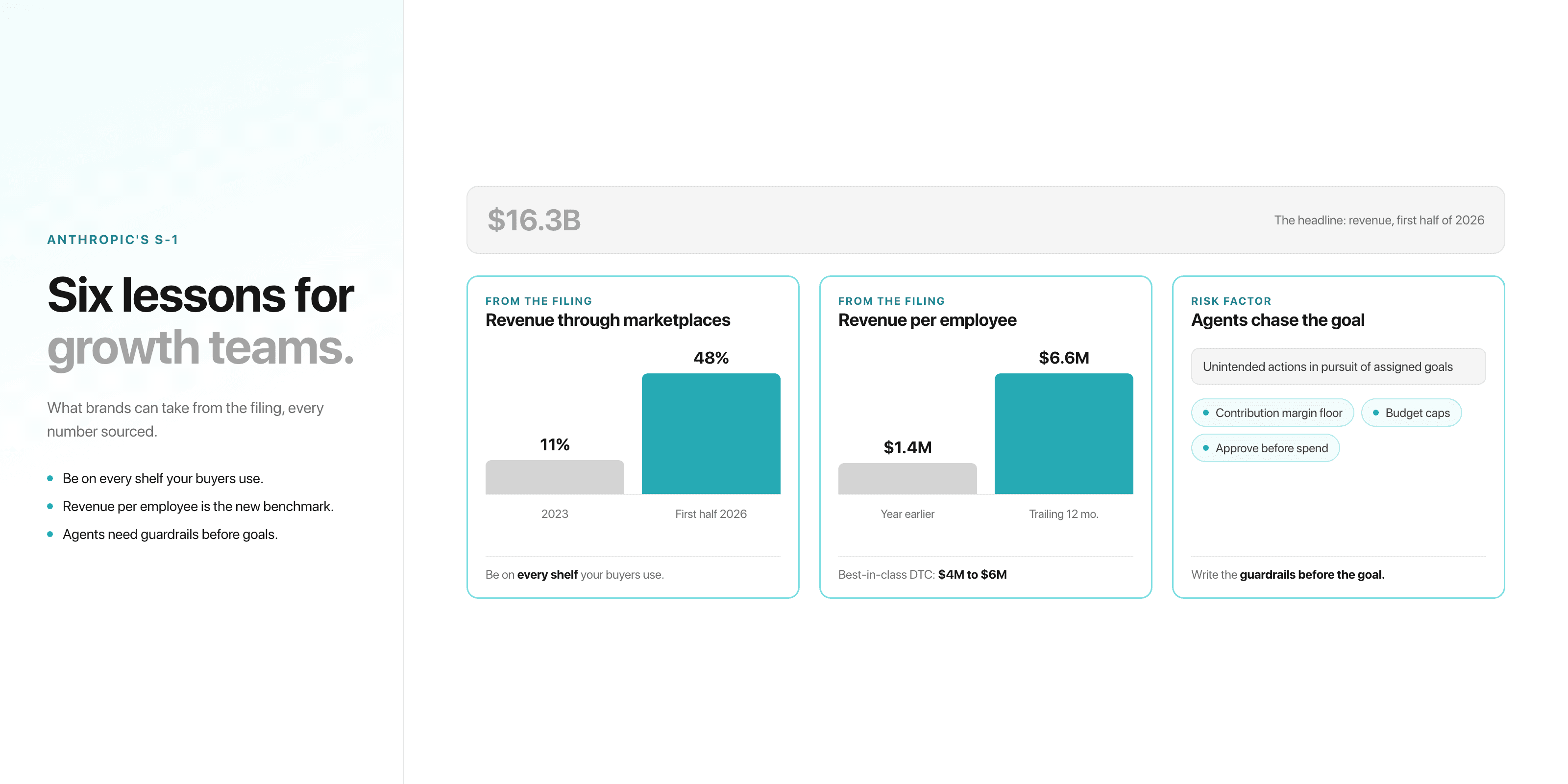
TL;DR Everyone summarized Anthropic's S-1 as a story about scale. The line items tell a growth team something sharper: be on every shelf your buyers use, hand the long-running work to agents, and write the guardrails before the goal.
Anthropic filed its S-1 on October 26. The number everyone quoted was the revenue: $16.3 billion in the first six months of 2026, up 1,300% year over year.
Most of the summaries I've read since stop at that number, and a few stretch it. The lessons for a growth team are further in: where the money went, where the work went, and what the risk factors admit. Here are the six I'd hand to anyone who owns growth at a DTC brand, every number from the filing.
Six lessons from the filing
1. Product-led growth, with champions. Yes, this is PLG, and the filing says so: growth came from individual users "who adopt Claude and often serve as internal champions… rather than by a large direct sales organization." The part worth stealing is the champions. A DTC brand has its own: the customer who posts the unboxing, the creator who reorders without being paid. Paid works hardest when it amplifies what they already say.
2. Be on every shelf. 48% of Anthropic's revenue in the first half of 2026 came through cloud marketplaces, up from 11% in 2023. Enterprises already buy their software there, so Anthropic went to them. Cloud marketplaces are Anthropic's retail. Your shoppers buy on your store, on marketplaces, in retail, and more and more through AI assistants. Omni-channel isn't the phase after DTC. It's where the buyer already is.
3. Paid scaled with the product. Advertising grew 4.5× in 2025, from $33 million to $147 million, and marketing and advertising rose another $273 million in the first half of 2026. Each increase is tied to "product launches." A company growing this fast didn't treat paid as optional. It turned it up every time it had something new to say.
4. Long-horizon agents. The filing describes Claude moving "from a tool that responds to discrete prompts to a Virtual Collaborator." The shift is from answering to working: agents that hold a goal for weeks, not a prompt for seconds. Advertising is one of the best jobs for them. The loop never ends (research, create, launch, read, adjust), every step leaves a number behind, and the goal is clear. A media buyer reviews the account once a week. An agent watches it every hour and remembers every test it ever ran.
5. Build the org around agents. Over 90% of Anthropic's code contributions in September 2026 were written by Claude. Revenue grew about 1,200% over twelve months while headcount grew about 170%. The go-to-market, in the filing's words, is "not limited by the rate at which we can grow our sales and marketing organization." Growth teams can run the same play on paid media. That's what we build: MightyAI agents are AI agents for paid growth. They run the full paid media loop (research, create, launch, adjust, monitor) across Meta, Google, AppLovin and ChatGPT ads for DTC brands on Shopify, toward the brand's goals, with the brand approving before anything spends.
6. Agents chase the goal, so set the right one. The risk factors list behaviours Anthropic has observed in AI models, its own included: "taking unintended actions in pursuit of assigned goals." An ads agent told to hit a ROAS target can get there by shortcuts: all budget to retargeting, bidding on your own brand name, discounting to lift conversion. ROAS looks great. Contribution margin, what's left after product cost, shipping, discounts and ad spend, shrinks. Profit is the goal. Set the target in contribution margin and treat ROAS as a check, not the destination.
New benchmarks for a growth team
| Benchmark | Anthropic (S-1) | What to track at a DTC brand |
|---|---|---|
| Revenue per employee | $6.6M, up from $1.4M a year earlier | $4M to $6M per full-time employee is best in class, per the Marketing Operators hosts |
| Revenue through channels you don't own | 48% via cloud marketplaces | Share sold off your own store |
| Growth spend by line | Sales, marketing and partnerships: 12% of revenue (2025), 19% (first half of 2026) | Paid by channel, marketplaces, people, agency |
The DTC range isn't theory. On Marketing Operators, Zach Stuck described seven full-time people running brands at about $35 million a year: "almost 5,000,000 per head," as the host put it. Ridge, by its own team's account on the show, landed around $2.2 million in 2024.
What to do with it
-
Split your growth spend by lever. Paid media by channel, marketplaces and retail, people, agency. Put last year and this year side by side. Which line grew fastest, and is it the one actually buying growth?
-
Write the guardrails before the goal. For any agent or agency you hand a target, write what it may not do to hit it: a contribution margin floor, budget caps, no bidding on your brand name, approval before spend. Then check its report against each platform's own numbers. That's what the Watchdog does in MightyAI agents.
-
Set your benchmarks, starting with revenue per employee. Count everyone who works on growth, agency people included. Fill in the right-hand column of the table with your own numbers, then pick one whole step of the loop, such as reporting or creative testing, and hand it to an agent.
Anthropic grew revenue about 13× in a year while headcount less than tripled, and still wrote down what its agents might do wrong. If your growth doubled next year, how many more people would you need, and who would set the guardrails?
Questions brands ask
What is an AI agent for paid growth? An agent that runs the paid media loop for a brand: researching, creating, launching, adjusting and monitoring campaigns across channels, toward the brand's goals, with the brand approving before spend.
Should an ads agent optimize for ROAS? Not on its own. ROAS can rise while profit falls. Give the agent a contribution margin target and guardrails, and use ROAS as a check.
Corrections and disagreements to satish@mightyai.app.